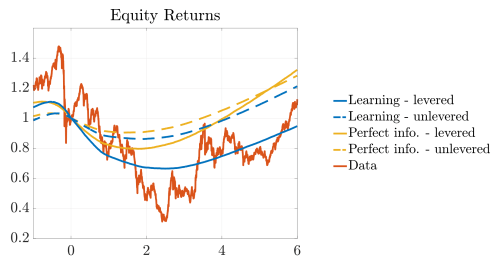
In this paper, we argue that leverage dynamics and learning about the stochastic frequency of jumps in consumption are the fundamental building blocks to understanding the long-lasting impact of crises on financial markets.
Models of learning about economic crises generate risk premia that rise at the onset of a crisis, but then fall as belief uncertainty fades. In contrast, empirical risk premia remain elevated during crises. We resolve this tension via leverage dynamics generated by the impact of learning on optimal default and capital structure decisions within a representative agent consumption-based model. Endogenously time-varying leverage creates a feedback loop: the learning-induced slow recovery in equity prices raises leverage, thereby further depressing equity values and keeping the equity premium and credit spreads persistently high as the crisis unfolds. We structurally estimate the model and show it closely matches the joint dynamics of consumption, equity risk premia, credit risk, and leverage, especially during crises, together with the term structure of credit risk and default probabilities.
Conference presentations: 2024 Midwest Finance Association, 2024 UBC Winter Finance Conference, 2024 Adam Smith Workshop, 2024 Oxford Saıd-VU SBE Macro-finance Conference, 2024 Western Finance Association, 2024 European Finance Association
 Dr. Lars-Alexander Kuehn